Shadow AI: The Risk Already Inside Your Organization
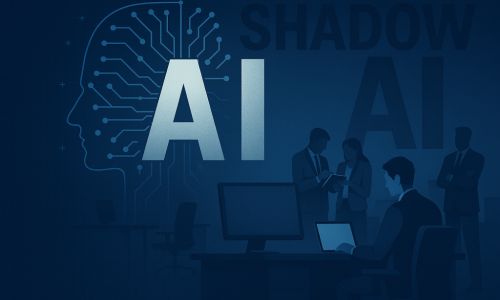
Picture this: a member of your sales team has a big proposal due tomorrow. They paste the client’s contract into a free AI chatbot, ask it to summarize the key terms, and fire off the proposal in half the time it normally takes. Simple. Smart. Efficient.
Not only a potential compliance violation — but possibly a data breach.
That’s Shadow AI in action. No malicious intent. No awareness of risk. Just someone trying to do their job better, using the tools they know work.
It’s happening in nearly every organization right now. And most leadership teams have no visibility into it at all
Artificial intelligence is transforming how work gets done. From drafting emails and analyzing data to writing code and summarizing meetings, AI tools are now embedded in daily business workflows. But alongside this productivity surge is a fast‑growing and largely invisible risk: Shadow AI.
Many organizations are investing heavily in approved AI platforms—yet employees are often using AI tools outside of IT, security, and compliance oversight. This gap between sanctioned AI strategy and real‑world usage is where Shadow AI thrives.
Understanding Shadow AI—and how to manage it without stifling innovation—is now a critical leadership responsibility.
What is Shadow AI?
Shadow AI refers to the use of artificial intelligence tools, models, or services by employees without formal approval, governance, or visibility from IT or security teams.
It is the AI‑era evolution of “shadow IT,” but with higher stakes.
Examples of Shadow AI include:
- Employees pasting sensitive documents into public AI chatbots to summarize or edit content
- Teams using free or personal AI accounts instead of enterprise‑licensed tools
- Developers calling external AI APIs directly from applications without review
- Browser extensions, AI meeting note‑takers, or copilots accessing company data without oversight
- AI features embedded in SaaS platforms that activate automatically without governance review
In most cases, there is no malicious intent. Employees are simply trying to work faster, meet deadlines, and stay competitive. The problem is that data, decisions, and workflows are now happening outside the organization’s control.
How Can Shadow AI Affect Your Business
Shadow AI is not just an IT policy issue—it is a business risk with financial, legal, and reputational consequences.
1. Data Leakage and Loss of Control
When employees input proprietary, customer, or regulated data into unapproved AI tools, that data may:
- Be stored or retained by third parties
- Be used to train external models
- Leave the organization permanently with no retrieval or deletion capability
Once data crosses that boundary, control is effectively lost.
2. Regulatory and Compliance Exposure
Shadow AI can easily violate regulations such as:
- GDPR
- HIPAA
- PCI‑DSS
- Industry‑specific data handling rules
Because usage is untracked, organizations may not even know they are non‑compliant until an audit, breach, or regulatory inquiry occurs.
3. Security Blind Spots
Unapproved AI tools create invisible attack surfaces:
- No audit logs
- No monitoring
- No incident response visibility
If sensitive data is exposed through an AI interaction, security teams may have no way to trace what happened, when it happened, or what data was involved.
4. Operational and Decision Risk
AI outputs can be inaccurate, biased, or misleading. When employees rely on ungoverned AI for:
- Financial analysis
- Legal drafting
- Strategic recommendations
…errors can propagate into business decisions, contracts, or customer interactions with real downstream consequences.
5. Reputational Damage
A single incident involving leaked customer data or confidential strategy documents can erode trust with customers, partners, and regulators—often faster than the organization can respond.
Many companies try to “ban” AI tools outright. This rarely works.
Shadow AI persists because:
- AI tools are easy to access and require no installation
- Employees are rewarded for speed and efficiency
- Approved tools often lag behind real business needs
- Enforcement without alternatives drives usage underground
The reality is simple: people will use tools that help them do their jobs better.
The goal is not to eliminate AI usage—it is to make safe, governed AI easier to use than unsafe AI.
Mitigating the Risks of Shadow AI
Effective Shadow AI mitigation balances visibility, governance, and enablement—not prohibition.
1. Establish Clear AI Usage Policies
Define:
- What data can and cannot be used with AI
- Which tools are approved
- Where human review is required
- Accountability for AI‑assisted decisions
Policies should be practical, readable, and aligned with how people actually work.
2. Provide Approved, Easy‑to‑Use AI Alternatives
Employees turn to Shadow AI when approved tools are unavailable or inadequate.
Offering secure, enterprise‑grade AI solutions reduces the incentive to go elsewhere.
3. Increase Visibility Across the Environment
Organizations need visibility into:
- Web‑based AI usage
- SaaS‑embedded AI features
- API integrations
- Browser extensions and agents
You can’t manage what you can’t see.
4. Implement AI Governance and Risk Review
Treat AI like any other business‑critical system:
- Vendor risk assessments
- Data classification controls
- Security and privacy reviews
- Ongoing monitoring
AI governance should be cross‑functional—IT, security, legal, compliance, and business leadership.
5. Train Employees on AI Risk (Not Just AI Power)
Most employees are unaware of the risks they introduce.
Training should focus on:
- Real‑world examples
- Data handling expectations
- When to stop and ask before using AI
The goal is informed use, not fear.
Shadow AI is not a future problem—it is already embedded in most organizations.
The question is no longer “Are employees using AI without approval?”
The real question is “Do we have visibility, governance, and safe alternatives in place?”
Organizations that respond with bans and blanket restrictions will fall behind.
Those that embrace AI responsibly—while managing risk—will move faster, safer, and with greater trust.
Have questions or need help with your AI implementation? Oversee My IT can help ~ Contact Us: Oversee My IT – Cybersecurity, Secure IT, Cloud services